A Brief Needs an Edge as Well as an Aim
A collaborative creative brief needs a clear boundary and an open question. Use this weeklong routine to give a group direction without prescribing its result.
A collaborative creative brief works best when it names both a boundary and an open question. Give a group a clear limit—such as working from one shared memory—then leave the form, materials, and interpretation undecided. The limit keeps the work in the same conversation; the question gives people room to answer in different ways.
Over a week, collaborators can shape that brief without turning it into a list of instructions. The routine below is for a small group beginning a shared creative project. Its purpose is not to produce agreement about what the finished work should look like. It is to agree on what the work is about, what it will not try to do, and what remains genuinely unsettled.
Day one sets the boundary without choosing the result
Begin with the project’s practical and conceptual limits. Practical limits might include the space where the work will be made, materials already available, or a deadline. Conceptual limits describe the territory the group intends to stay within: a place, a question, a shared experience, or an audience.
Write down candidate boundaries as plain statements. “Make something about the neighborhood” is broad enough to invite almost anything. “Respond to how people find their way through the neighborhood” gives the work a subject without deciding whether it becomes a map, sound piece, set of signs, or something less obedient to nouns.
Ask each collaborator to name one boundary that would make the work more coherent and one that would make it feel overmanaged. Compare the answers. Keep a limit only if people can explain what it helps the group attend to. Drop limits that merely describe a preferred aesthetic in disguise, such as “keep it elegant” or “make it feel complete.” Those phrases tend to smuggle in a result while pretending to be neutral.
End the first conversation with a short boundary statement. It should say what is in scope and, if useful, what is out of scope. Avoid settling the medium or dividing tasks before the group has agreed on the territory.
Day two writes an open question worth working on
A useful open question has more than one plausible answer. “How can we make a welcoming entrance?” quietly assumes that the work must be an entrance and that welcoming is the agreed aim. “What makes a place feel open or closed?” allows the group to examine the terms before deciding what to make.
Write several questions, then read them aloud. Listen for questions that already contain a solution, a moral lesson, or a favored viewpoint. Revise those until the group could answer them through different forms and disagree about what they mean. A question should be specific enough to return to during making, but not so narrow that every contribution sounds like an assignment.
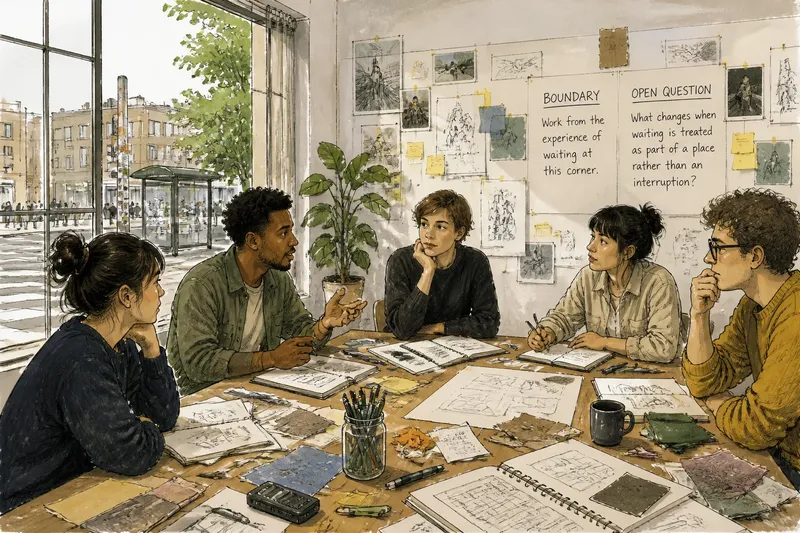
Say you are collaborating on a shared project about a neighborhood corner where people often wait. The boundary could be “work from the experience of waiting at this corner.” An open question might be “What changes when waiting is treated as part of a place rather than an interruption?” The group could answer with a text, a drawing, a sound, or a combination. None is selected in advance.
Keep the boundary and question visibly separate. The boundary establishes the project’s edge. The question gives collaborators somewhere to think inside it.
Day three checks whether the brief leaves room
Test the draft by asking each person to propose a different possible response. The proposals do not need to be good ideas, and they are not commitments. Their job is to reveal whether the brief allows genuine variation.
If everyone proposes nearly the same thing, the question may be too leading or the boundary may be doing too much. If proposals have no meaningful connection to one another, the boundary may be too loose. Revise one part at a time: broaden or narrow the boundary, or make the question less loaded. Then try again with fresh possibilities rather than defending the first draft.
Also ask what the brief leaves undecided. Useful open territory may include medium, scale, tone, sequence, or how individual contributions relate. If the group has already settled all of these, the question may be decorative rather than open.
Day four names exclusions and decision rights
An edge is clearer when collaborators know what is not being asked of them. State exclusions in ordinary language: the project is not intended to represent every resident, settle a disagreement, or produce a single account of an experience. Exclusions are not a claim that those subjects do not matter. They stop the brief from promising work the group has not agreed to do.
Clarify who can revise the brief and how. A group may decide that anyone can suggest a change, while changes to the boundary require discussion by everyone involved. The exact arrangement depends on the collaboration, but silence should not become an accidental veto and a confident speaker should not become an accidental owner.
Keep the decision process separate from the creative answer. Agreeing how to amend the brief does not require agreeing what the work will say.
Day five tries the brief against actual materials
Bring the draft into contact with the materials or tools the group might use. This is not a commitment to a medium. It is a way to notice whether the brief encourages useful exploration or forces a predetermined treatment.
For example, collaborators might place scraps of paper, a voice recorder, and a sketchbook on the table, then ask what each makes easier to notice about the shared question. The purpose is not to select the most impressive object. It is to see whether the question stays alive across different ways of working.
If a material makes one answer seem inevitable, note that pressure. The group can choose it later, but the brief should not pretend the choice is neutral. If the question becomes hard to discuss whenever a particular tool is present, set that tool aside for the next conversation.
Day six rewrites the brief in a few sentences
Draft a compact version that a collaborator could read without needing the history of the discussion. Include the subject or territory, the open question, the main boundary, and any important exclusion. Keep proposed forms and solutions out unless they are actual constraints.
Read the draft aloud. Replace abstract language with words people can act on. “Explore connection” may sound inviting but offers little guidance; “look at how people signal that a shared place is available to others” gives the group something to observe or interpret without prescribing the work’s shape.
Then ask each person what they think the brief permits, what it rules out, and what it leaves open. If the answers differ in a way that changes the project, revise the wording. Some differences will be productive interpretations; others mean the brief has failed to communicate a boundary.
Day seven agrees on a starting brief, not a contract
Read the final draft together and decide whether it is clear enough to begin. The group does not need to predict the finished work. It needs a shared point of departure and a way to notice when the project has wandered beyond its agreed territory.
Keep the brief somewhere visible during early work. Revisit it when a proposed direction feels unrelated, or when a boundary starts to narrow the work more than the group intended. Amend it through the process the collaborators agreed on, rather than letting the first draft acquire authority simply because it was written down.
What makes a collaborative brief useful?
How narrow should a creative brief be?
Narrow it enough that collaborators can tell when an idea belongs to the project, but not so far that only one form or answer fits. A boundary should organize attention, not dictate taste.
Should a brief specify the materials?
Specify materials when they are a real constraint, such as a shared supply or a required setting. Otherwise, leave them open long enough for the question to meet different possible ways of working.
What if collaborators disagree about the question?
Find out whether the disagreement concerns wording, the project’s territory, or a difference in what people hope to make. Revise the question if the group can make it more honest; do not conceal a substantive disagreement behind a smoother sentence.
Can the brief change once making begins?
Yes, if the group has agreed how changes are proposed and accepted. A brief should guide decisions, not prevent collaborators from noticing that the original boundary no longer serves the work.
A clear collaborative creative brief is not a miniature version of the finished piece. It is a shared edge around a question the group has not answered yet. When the work surprises its makers, the brief has done its job if they can tell whether that surprise belongs inside the project.