Paper, Fabric or Reclaimed Card for a Group Collage?
Choose paper, fabric or reclaimed card for a group collage by matching mark-making, layering and shared contributions to the surface each material supports.
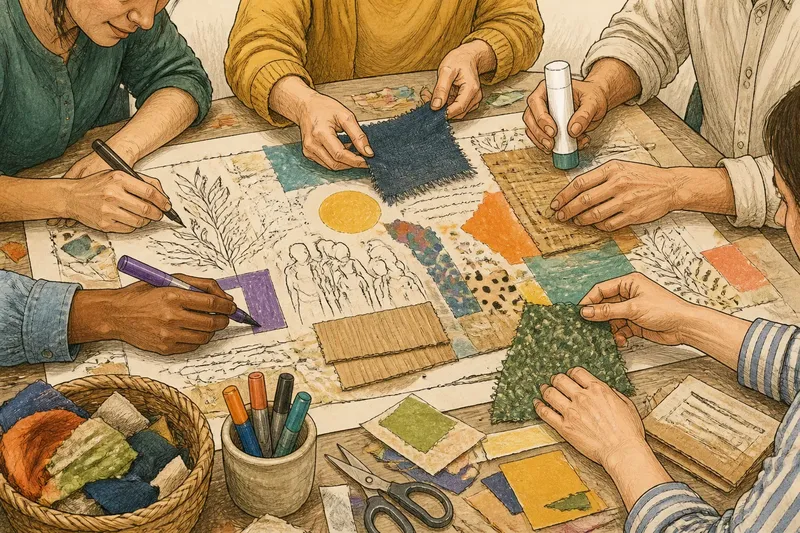
For a group collage, the surface changes what people can contribute: paper accepts quick marks, fabric brings texture, and reclaimed card can support weightier pieces. Choosing paper, fabric or reclaimed card for a group collage means deciding how the group’s ideas should meet on the same ground.
Choose the surface by the contribution it invites
Before gathering supplies, decide what participants are likely to make. A collage built from drawn lines, cut shapes and small notes has different needs from one that depends on cloth scraps, raised elements or broad painted areas. The surface should make those contributions possible without forcing everyone into the same technique.
Paper is a flexible starting point for drawing, writing, cutting and gluing. Smooth drawing or mixed-media paper gives markers and colored pencils a predictable path. Heavier paper can tolerate more adhesive and repeated additions than thin sheets, though wet media may still buckle it. If handwriting and fine detail matter, a relatively smooth surface is often easier to share.
Fabric adds a tactile, flexible quality. Woven cotton or canvas scraps can take fabric markers, stitched details and attached shapes, but their texture may interrupt fine lines. Fabric also bends rather than behaving like a rigid sheet, so it suits work intended to hang loosely or be handled as a textile piece. It is less convenient when the group wants crisp cuts and a flat, highly controlled layout.
Reclaimed card, such as clean packaging board or the face of an old box, provides a firm base for heavier paper pieces and shallow raised elements. Its surface varies: a coated carton may resist some markers or glue, while an uncoated panel may absorb them. Existing folds, seams and printed areas are not automatically flaws; they can become part of the composition if participants are happy to work around them.
Write down the main actions the group expects to use: draw, paint, write, cut, layer, stitch or attach. The material that supports most of those actions with the least friction is a sensible first choice.
Compare how the surfaces take marks
Mark-making is the first practical difference participants notice. On paper, pencils, crayons and many markers produce familiar lines. Some papers have enough tooth to hold dry media; smoother sheets can make small lettering and sharp outlines easier. A paper surface can also be divided into zones without much preparation, which helps when several people are working at once.
Fabric changes the feel of a line. A woven surface may catch a marker, and a loose weave can let ink spread beyond a narrow stroke. Fabric crayons or markers intended for textiles may be more suitable than ordinary pens, but check the product directions before using them. Fabric can also invite contributions that paper rarely does, such as a stitched line, a folded edge or a patch with its own texture.
Cardboard offers a broad, steady area for thick lines and pasted paper. Its surface may include print, gloss or a thin coating, so marks can look uneven from one panel to another. A clean, plain section is useful for drawing; printed sections can serve as found color or pattern. The practical question is not whether the card is perfectly blank, but whether its existing marks support the image the group wants to make.
Say a group wants handwritten labels, broad marker shapes and cloth patches. They start with a smooth sheet of mixed-media paper, a fabric offcut and markers intended for the materials. They write and draw on the paper, then arrange the cloth as an attached accent. The expected result is legible text alongside visible texture, with each material handling the contribution it suits.
Plan layers around weight and flexibility
Layering changes the demands on a surface. Paper handles overlapping cutouts and thin painted marks well, but many wet additions can soften or distort it. When a collage will have several pasted layers, a sturdier sheet can offer more support. Let each layer settle according to the adhesive instructions; a soggy stack is not improved by enthusiasm.
Fabric accepts layers that bend with it: another fabric patch, a soft paper shape or thread. Stiff embellishments can make a textile surface buckle or hang awkwardly. If the final piece needs to lie flat, consider using fabric as a smaller accent on a paper or card base rather than building the whole work from cloth. If movement and drape are part of the intended effect, a flexible fabric base may be the more natural choice.
Reclaimed card can carry substantial paper shapes and lightweight dimensional pieces, but its folds and edges affect where layers sit. A box panel may curve or spring at an old crease. Orienting the panel so a fold becomes a boundary can make that feature useful; attaching pieces across a fold may be less dependable. Keep the collage’s overall depth modest if it will need to stack or travel.
For a mixed-material piece, decide which surface is the base and which materials are accents. A single base gives the group a shared visual field. It also avoids turning the session into a contest over whose adhesive can persuade a scrap of cloth to stay on a slick carton.
Make room for different kinds of contribution
A shared collage works better when the surface offers several ways to take part. Paper makes it easy to contribute a small drawing, a phrase, a cut shape or a colored patch. Participants can prepare pieces separately and bring them to the shared sheet, which is useful when people prefer to work at different speeds or with different tools.
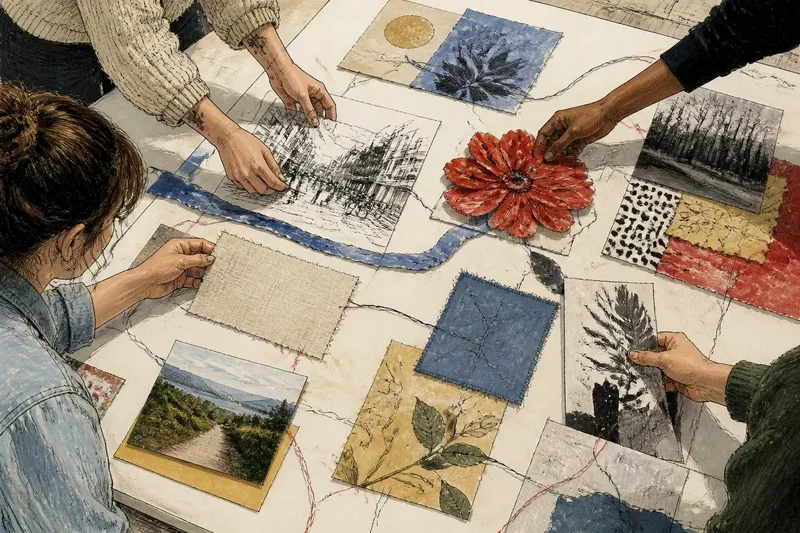
Fabric can make tactile contributions more prominent. Someone who does not want to draw may select a patterned scrap, arrange its direction or add a stitched mark. Because cloth pieces vary in thickness and edge, agree on whether raw edges are welcome or whether participants should fold them under. That small decision prevents a neat-cut paper piece from being judged by standards that do not suit a textile fragment.
Reclaimed card gives participants a surface with visible history. A fold, shipping label or printed block can prompt a response, while the firmer base allows people to place larger shapes without the sheet shifting as easily. If the group prefers a clean visual field, choose a plain, uncoated area. If it enjoys responding to what is already there, leave some original printing visible.
Set out a limited selection of mark-making tools and prepared scraps rather than every supply in the room. A shared palette can help contributions sit together, while a mixture of textures keeps the result from becoming uniform. The aim is not to make each contribution match; it is to give them a surface on which they can be read together.
Prepare the materials before arranging the composition
Once the surface is chosen, inspect it for loose fibers, loose paper, grease, sharp edges or unstable folds. Use clean, dry pieces. Flatten paper and card as needed, and trim a reclaimed panel so its edges are comfortable to handle. For fabric, remove loose threads that would interfere with drawing or gluing, unless those threads are intended to remain part of the work.
Check a small offcut or hidden area with the intended marker, paint or adhesive. Look for bleeding, beading, discoloration or a bond that does not hold. This is a simple compatibility check, not a promise about how the finished collage will behave. Product labels, manufacturer instructions and local rules take precedence where they apply.
Place the base where everyone can reach it, then arrange cut pieces without attaching them. Leave open areas for later additions and make sure the group can see the whole composition. On paper or card, light pencil marks can indicate broad zones; on fabric, pins may be unsuitable for a shared workspace, so temporary placement on a table is often simpler.
Choose adhesive to suit the materials and the way the finished work will be used. Glue sticks may suit lightweight paper, while heavier or textile pieces may call for an adhesive intended for those materials. If the piece needs to flex, a stiff glue layer can undermine that intention. Follow the product directions and provide ordinary ventilation and cleanup appropriate to the materials in use.
Which surface suits this collage?
Is paper the easiest surface for a first group collage?
Paper is often straightforward when the group plans to draw, write, cut and layer lightweight shapes. Choose a sturdier sheet if the collage will receive several additions or some wet media.
Can fabric work as the main collage base?
Yes, if flexibility and texture are part of the intended result and the group is comfortable using tools suited to cloth. It is a less natural fit for crisp lettering or a piece that must remain rigid.
What kind of reclaimed card should the group use?
Look for clean, dry board with a stable, accessible surface and a shape that suits the composition. Packaging print, gloss and folds can be used as visual features, but they may also affect how marks and adhesive behave.
Can paper, fabric and card appear in one collage?
They can, if the base and attachment methods suit the pieces being added. A firm card or paper base can carry small fabric accents; a fabric base can carry flexible paper shapes when the adhesive and desired drape are compatible.
Choose the surface that supports the next decision
When the options still seem evenly matched, make a small layout from spare pieces before committing the group’s work. Notice whether the writing stays legible, the layers sit as intended and participants can reach the shared area without displacing one another. The useful surface is the one that makes the group’s next contribution clear.
For a collage centered on drawn marks and cut shapes, paper is usually the most direct choice. For texture, stitching and movement, fabric offers more possibilities. For heavier layers and a firm base, reclaimed card earns its place. A group collage can combine all three, but choosing one material to lead gives the other contributions a clear place to land.
Keep paper, fabric or reclaimed card for a group collage as a decision about contribution: choose the surface that lets people add something distinct while keeping the shared work easy to arrange and handle.