A Small Showing for Work Still in Progress
A small showing for work still in progress helps viewers give useful responses without mistaking an unfinished piece for a final presentation.
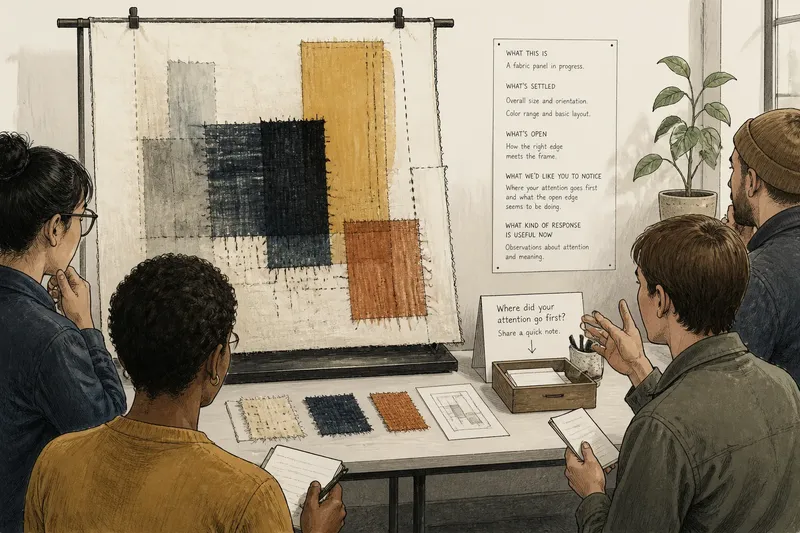
A small showing for work still in progress works best when viewers know what kind of attention the piece needs. Put one unfinished object in a clear setting, name the decision still open, and ask for a response that can influence the next session. The aim is not to make rough work look finished. It is to make the unfinished part legible.
Give the showing one job
A display can invite several kinds of attention: close looking, practical advice, emotional response, or help choosing between directions. One showing rarely serves all of them equally. Pick the one useful job before deciding what to put on the table or wall.
For a group-made piece, the job might be to learn whether the current arrangement reads as crowded or deliberate. It might be to notice where viewers expect a seam, a handle, or a change in surface. Those are different questions, even if the same object prompts both.
Say a group has assembled a fabric panel whose central patch keeps drawing the eye. They want to know whether that emphasis feels intentional, not whether visitors like the colors. They display the panel with a note asking where the eye lands first. The likely useful result is a set of specific observations about attention, rather than a round of general approval.
Write the purpose in a sentence before setting anything out. If it takes a paragraph, the showing may be trying to do several jobs at once.
Choose what belongs in view
Show the piece at the scale and in the orientation people need to read it. A small object may need a low platform; a paper work may need a wall; a sound work needs a place where a short listening encounter is possible. Keep the arrangement plain enough that props do not become competing exhibits.
Include supporting material only when it answers a question the object cannot answer by itself. A fragment of discarded material can clarify a choice of texture. A sketch can show which part of a composition is under discussion. A pile of every draft, note, and leftover tends to turn a focused viewing into an archaeological dig.
- Show the unfinished piece in the form viewers will encounter it, rather than presenting a photograph when the physical surface matters.
- Add one or two relevant studies, samples, or process marks if they explain a live decision.
- Leave out unrelated versions that invite comparison the group is not asking for.
- Make the unfinished area visible without disguising it as a deliberate finish.
- Set aside enough space for viewers to look without handling the work unless handling is part of the invitation.
For a digital or projected work, make sure the display can be viewed without requiring a visitor to operate unfamiliar software. A still frame, a short loop, or a brief live demonstration may communicate more than an open file with unexplained controls.
Supply the context viewers actually need
Give viewers enough information to interpret what they see, but not so much that the display supplies the response in advance. Useful context usually includes who is making the piece, what stage it has reached, and which decision remains open. Keep background history to what affects that decision.
A concise card can state:
- What the piece is, in plain language.
- Which parts are settled and which remain open.
- What the makers would like viewers to notice.
- What kind of response would be useful now.
Use concrete terms rather than a broad invitation to “share thoughts.” If the group wants to understand whether a repeated shape reads as a path, ask where viewers think it leads. If the concern is material, ask what the surface seems to invite a person to touch or avoid. Specific wording gives people a handle without telling them what answer to produce.
Be careful not to present an unresolved choice as a flaw waiting for correction. “The edge is still open because we are deciding how it should meet the frame” gives viewers a reason for the visible gap. It does not ask them to repair the work on the spot.
Ask for responses the makers can use
Feedback becomes easier to sort when the prompt matches the decision. Ask for observations before suggestions if the group is still trying to understand how the piece reads. Ask for alternatives only when the makers are ready to consider changes. Advice offered too early can crowd out noticing; advice offered too late can be an elegant inconvenience.
Useful prompts include:
- “Where did your attention go first?”
- “What part seems most resolved, and what makes it feel that way?”
- “What do you think this opening or gap is doing?”
- “Which of these two directions would you want to look at longer?”
Offer a response method that suits the setting. Viewers can leave a short written note, speak with a host, or place a marker beside one of two options. Avoid turning a casual display into a public vote if the makers need explanation rather than a count of preferences.
Tell visitors whether they may touch, move, or photograph the work. If the group wants only verbal impressions, say so plainly. If touch matters, make the permitted interaction obvious and keep fragile or private components out of reach.
Keep the unfinished work in the makers’ hands
A showing is an invitation to contribute attention, not a transfer of authorship. The makers decide which comments to use and which direction to pursue. A host can help by collecting remarks without debating them on behalf of the group.
When several people made the piece, agree beforehand who will receive comments and how they will be shared. A single spokesperson can prevent visitors from having to guess whom to address, but that person should not imply that one maker’s preference settles the group’s decision.
It can help to separate response from action. Gather observations during the showing, then review them together afterward. That gives quieter collaborators room to consider the comments and keeps a persuasive visitor from steering the work while everyone is standing around it.
How should a small showing handle common questions?
How much of the process should be displayed?
Show only the process material that helps viewers understand the open decision. A relevant sketch or sample is often clearer than a full archive of drafts. Keep the main piece visually central.
Should viewers be allowed to suggest changes?
Yes, if the makers want suggestions at this stage. State that preference on the display card and ask for suggestions tied to the named decision, rather than inviting a redesign of the whole piece.
What if viewers disagree with one another?
Keep the different responses visible without forcing a quick consensus. A disagreement may reveal that the work communicates more than one thing, which the makers can consider after the showing.
How can the display avoid looking finished?
Leave the unresolved area visible and describe it honestly. Do not add decorative labels or staging that imply the piece is a completed presentation when it is still being shaped.
Close the loop after people leave
Set a short time for the makers to sort responses while memories of the viewing are fresh. Group comments by subject: what people noticed, what they misunderstood, and what alternatives they proposed. These categories keep an observation from being mistaken for an instruction.
Then name the next decision in ordinary language. The group might keep the current arrangement, make a small adjustment, or create another version to compare. Not every comment needs a reply, and not every suggestion deserves a trial. The useful question is whether a response helps the makers see the work or its choices more clearly.
For a small showing for work still in progress, a few well-directed observations are more valuable than a wall of unfiltered opinion. End the session with one agreed next action and a note of what remains unresolved. That gives the piece somewhere to go without pretending the room has settled its future.